
 Visitor Express SiteGuard visitor.express SiteGuard
Secure site connectivity — without a static IP
SiteGuard is NetFM's answer to providing secure remote access using intelligent edge devices — with no longer any need for static IPs or port-forwarding rules. Our customers operate over geographically large areas across the UK, which demands many types of connectivity: fibre broadband, fixed line, 4G/5G mobile networking and Starlink. We've designed SiteGuard to work across these heterogeneous networks and provide a single access-control page within Visitor Express.
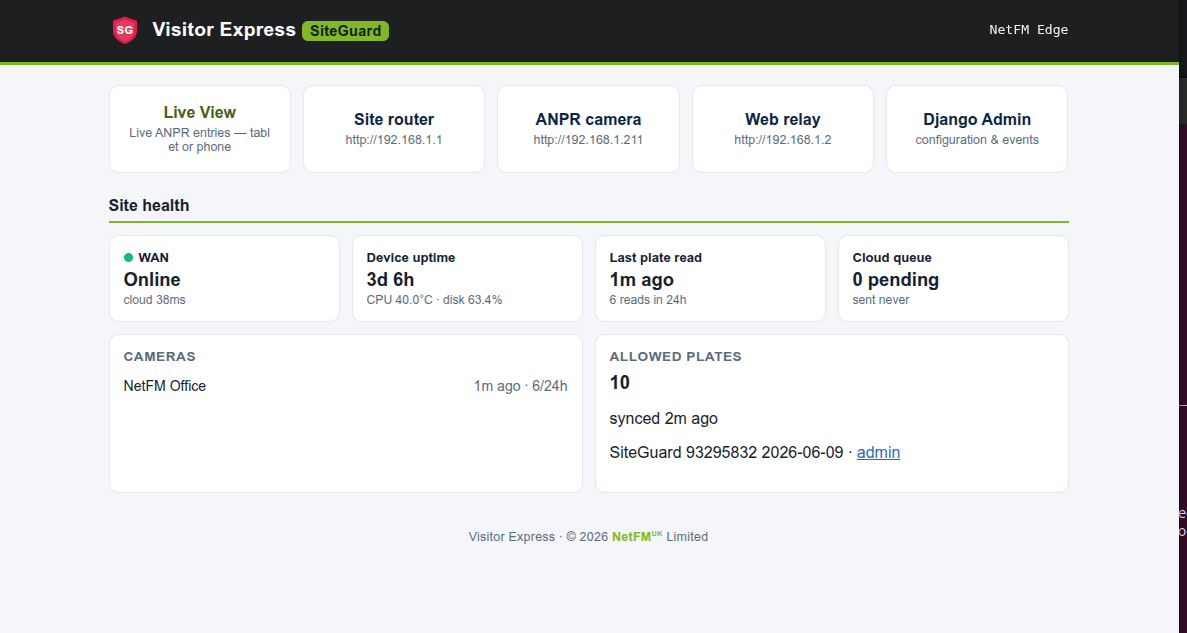
SiteGuard incorporates a WireGuard VPN network based on Tailscale alongside an intelligent edge device that manages all site-based services — allowing fully autonomous operation using direct local access to control digital access screens and barriers, with the ability to cache over two weeks of on-site booking and entry data.
SiteGuard Brochure
An intelligent edge device at every site, connected to your core platform over a private, encrypted mesh network — coordinated by NetFM's own dedicated control server. No rented static IP, no open firewall ports, no data on the public internet.
Visitor Express · SiteGuard brochure (PDF) ↓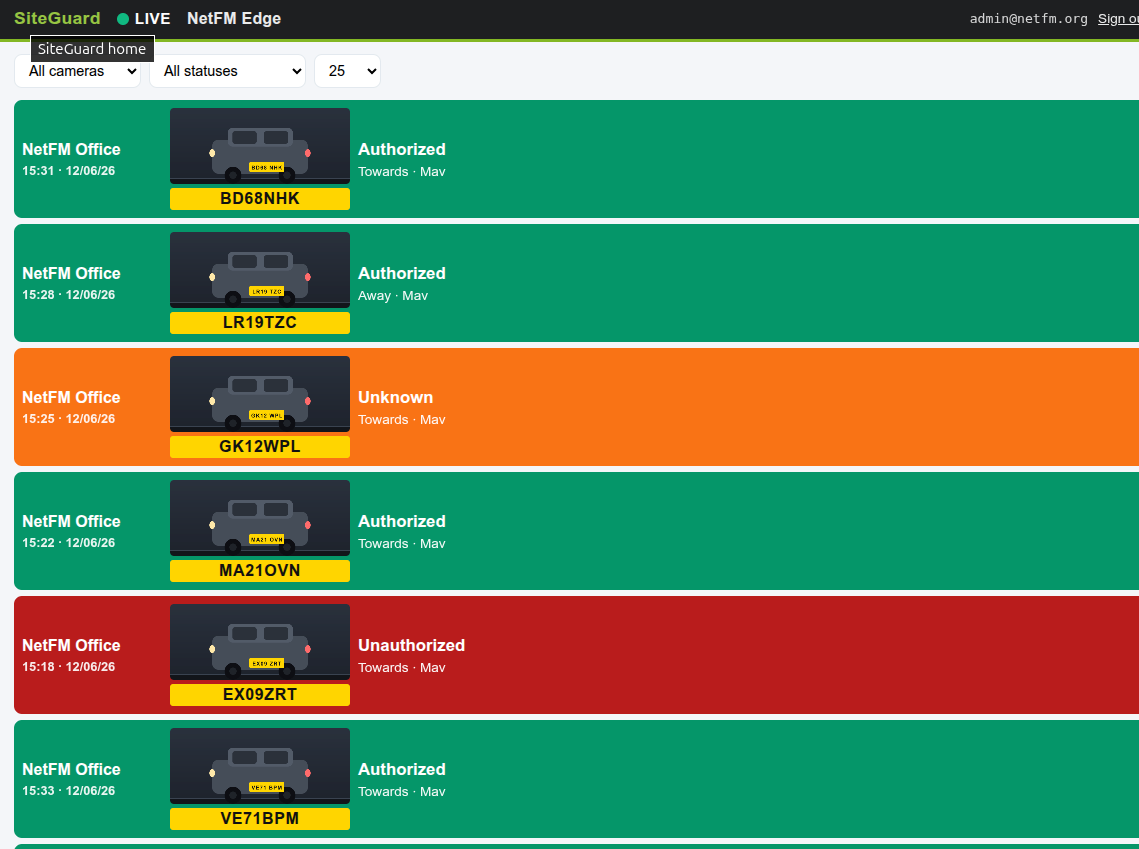
The old way
A rented static IP and a row of open ports
Reaching equipment at a remote site has traditionally meant a router with a public static IP address and a stack of port-forwarding rules — the camera on one port, the web relay on another, the router's own admin page on a third. Each one is a door onto the public internet, guarded by little more than a password.
- ✕ Static IPs cost money — a monthly line-rental add-on from the ISP, every site, every month.
- ✕ On 4G/5G a public IP is often expensive or simply unavailable behind carrier-grade NAT (CGNAT).
- ✕ Every forwarded port is internet-facing — continuously scanned and brute-forced.
- ✕ A single reused or weak device password exposes the whole access-control system.
# Typical legacy site — everything on one public IP
203.0.113.10:9001 → ANPR camera admin
203.0.113.10:9002 → web relay / barrier
203.0.113.10:443 → router admin
# 3 open ports · 1 rented static IP · public-facing
The SiteGuard way
One private mesh. Zero open ports. No static IP.
The SiteGuard edge device joins a private mesh network built on Tailscale (WireGuard®), coordinated by NetFM's own dedicated Headscale control server. The device dials out to join the mesh — it never needs an inbound port, a static IP, or any change to the customer's firewall.
SiteGuard edge device
Behind any connection — 4G/5G, broadband, even CGNAT. Makes outbound-only connections.
Encrypted WireGuard tunnel
Direct, end-to-end encrypted, peer-to-peer. Reachable only by name (site.cn.netfm.org) on the tailnet.
Visitor Express
Bookings, allow-lists and plates flow down; arrivals and audit logs flow back — all inside the mesh.
Security architecture
How the private mesh works
Tailscale splits a network into three independent layers — and that split is exactly why SiteGuard is both cheaper and more secure than the static-IP approach.
Headscale decides membership. It distributes keys and addresses — but never sees traffic.
ACL tags partition the mesh — controlling which nodes may reach which. Default deny.
WireGuard carries the actual traffic, encrypted end-to-end between peers.
Headscale — the coordination layer
Tailscale is a mesh VPN built on WireGuard: rather than funnelling traffic through a central hub, devices form direct peer-to-peer connections, traversing NAT and CGNAT to reach each other. Headscale is a self-hosted re-implementation of Tailscale's coordination server, so NetFM runs the standard Tailscale clients on every device while the control plane lives on its own UK infrastructure. Its job is deliberately narrow: it distributes each node's public key and overlay address so the fleet can find one another — and nothing more.
Security property: Headscale only replaces the control plane. The WireGuard private keys never leave the devices, so a fully compromised coordinator still cannot decrypt a single packet — it controls membership of the network, not the traffic within it.
The mesh and NAT traversal
Once nodes know each other's keys, they connect directly — end-to-end encrypted, peer-to-peer — even when both ends sit behind NAT or carrier-grade NAT, by learning their public endpoints and punching through. Where a hard symmetric NAT blocks a direct path, traffic falls back to an encrypted DERP relay that forwards already-encrypted packets and cannot read them.
WireGuard — the encryption layer
WireGuard fixes one modern cipher suite (Noise · Curve25519 · ChaCha20-Poly1305 · BLAKE2s) with nothing to negotiate — so there is no downgrade attack and effectively nothing to misconfigure. ChaCha20 runs at full speed on the ARM CPUs in our edge devices, with no AES-hardware dependency. Keys re-handshake every few minutes for perfect forward secrecy, and the interface is silent by default: a port scan of a site's WireGuard port returns nothing — invisible to anyone without a valid key. Each peer is bound to its public key and an allowed set of addresses (cryptokey routing), so identity and routing are the same cryptographic fact — there is no separate firewall to drift out of step.
Default-deny segmentation
Devices enrol with server-assigned ACL tags baked into their identity — a device cannot claim a tag for itself. The policy then states which tags may reach which, and anything not explicitly allowed is denied. Each customer's sites reach the shared Visitor Express service, but one customer's devices have no path to another's — the path simply does not exist.
Denied peers are invisible
A device in one group never receives another group's keys, endpoints, or even its existence — with no key, a handshake is cryptographically impossible. Nothing to scan or attack.
Identity is cryptographic
Identity is a key pair generated on-device and never transmitted — not an IP address that can be spoofed. A device cannot impersonate another any more than it can forge a signature.
No inbound exposure
Every connection is outbound-initiated — to the coordinator and to peers via NAT traversal. Customer sites open no inbound firewall ports, simplifying every security review.
Zero data at rest — nothing to recover
The edge device holds all of its working data — captured plates, snapshots, queues and event logs — in a RAM-backed filesystem (tmpfs), never on permanent storage. Because RAM is volatile, a device that loses power retains nothing: removing a unit from site, or simply powering it off, leaves no plate history, no images and no personal data behind. There is no disk image to forensically extract — the data ceases to exist when the power does, so a device taken off site carries zero data with it.
Resilient even if the control server goes down
Because the control plane is not in the data path, every node caches its peer list and policies locally. If NetFM's Headscale server is ever unavailable, all existing connections keep working — sites stay reachable and the edge keeps making access decisions. Only new device enrolments, key rotations and policy changes pause until the control server returns.
Source: Tailscale — “What happens if the coordination server is down?” and Control and data planes.
Removes the cost. Enhances the security.
No static IP, no rental
Works on any link — 4G/5G, broadband, even CGNAT. The recurring ISP static-IP charge disappears at every site.
Zero open inbound ports
Nothing is exposed to the public internet. No internet-facing camera, router or relay admin pages to scan or brute-force.
End-to-end WireGuard encryption
Modern, audited cryptography on every byte between the site and the core — never in the clear, never on the open internet.
UK-hosted private control plane
Coordination and keys stay on NetFM infrastructure — data sovereignty by design, not a shared third-party SaaS.
Out-of-band remote support
NetFM securely reaches cameras, routers and relays for maintenance — without the customer opening a single port.
Fast, clean deployment
Enrol the device, get a name on the mesh. No firewall changes, NAT rules or static-IP paperwork at the customer site.
See SiteGuard on your site
Local-first access control with secure, static-IP-free connectivity and a UK-hosted private control plane. Book a demo and we'll show you the edge device, the guard view and the mesh.